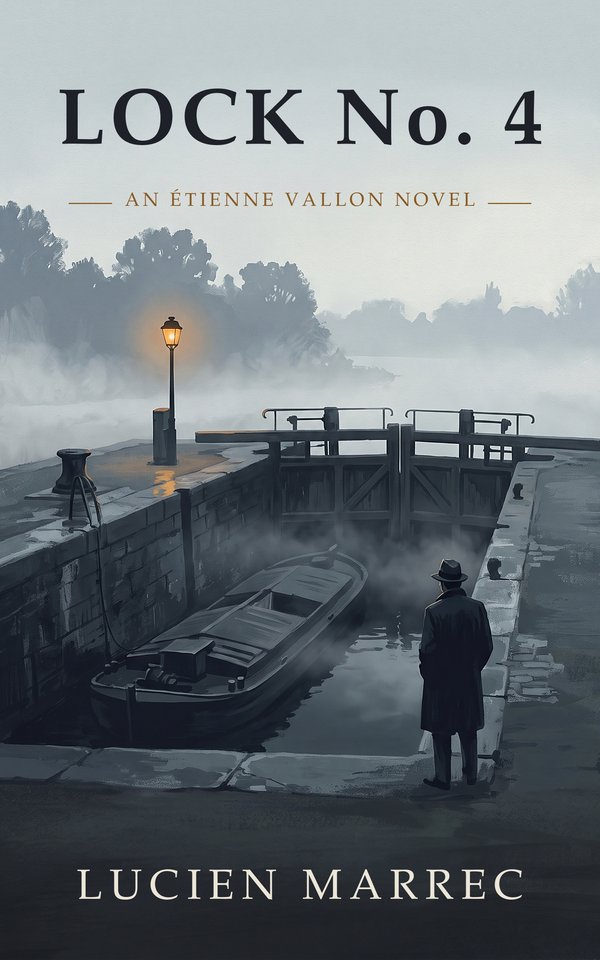
Lock No. 4
November 1935. Port-au-Brème, a small port on the Channel coast.
At three in the morning a barge rams the gates of Lock No. 4. Her skipper, Léonard Cassel, is dead, his mouth packed with pebbles from the beach they call the Devil’s Comb.
Étienne Vallon keeps the lock now. For ten years he was a police inspector in Marseille, until a witness in his care was murdered. Since then he has asked nothing of anyone, and answered as little.
But the gendarmerie sergeant wants Cassel’s death written off as an accident. The dead man’s coded notebook lists who in town is paid every month. And somebody is ready to blow up the lock to keep it that way.
Vallon has a burned hand, an old carbine, and very little time.
Ebook (Kindle Unlimited) and paperback, November 2026.
Read the opening
At three in the morning the fog had closed over Port-au-Brème and the harbor seemed to have been erased. The canal still ran through it, black and narrow between its stone walls, but the far bank had disappeared. Somewhere beyond the mole, the warning horn sounded every forty seconds. Each long note traveled through the mist like a breath from a sleeping giant. Étienne Vallon stood beside the lower chamber of Lock No. 4 and counted the silence between them.
He had begun counting in another war. In those days, the seconds between a whistle and the fall of shells had been worth measuring. The habit had survived the war, as habits did, while more useful things had not. Now he counted horns, footsteps, the beats of an engine in fog. He wore his cap low and his coat collar high, though the damp found its way through both. The chill had settled into the stone and iron long before midnight.
At this hour the assistant keeper ought to have been asleep in his room above the machinery. Old Maurice would be dozing in the gatehouse beside his stove, a newspaper folded over his face. No barges were due until dawn. Yet Vallon had come down as he often did after two, unable to stay in bed. He checked the water gauge, pressed his palm to the cast-iron gate, and listened for any hint of strain. The place was old, built before the war: two pairs of gates, a forty-meter chamber, granite walls green with water, and hand wheels that Maurice insisted on greasing with fish oil every Saturday. Oil from a modern drum, he said, would eat the metal. Vallon liked the lock because its workings were plain. A man could touch them, hear them, and know when they were under strain.
Ypres returned to him every autumn, though he no longer thought of it as a memory. It came as a cough that rose from below his ribs and left his lungs tight. He waited for it to pass with his fist pressed to his mouth. In 1918, mustard gas had smelled of garlic and wet mustard. He could still find that smell in damp cellars where no gas had ever been. When he could breathe again, he reached into his coat. His cigarettes had turned limp with damp. He struck a match, but the cigarette would not catch, and he put it away.
Then he heard an engine. It was a single-cylinder Bolinder, beating unevenly somewhere beyond the bend, a heavy chug broken now and then by a hollow pause. The rhythm called to mind a lame man hurrying to keep up. Vallon turned toward the sound and listened. In weather like this, barges anchored by the salt works and waited for daylight. Only drunkards and men with reasons to avoid notice traveled the canal at night. Port rules required a skipper to sound his horn once a minute inside the harbor. This one had not sounded it.
Vallon leaned over the iron rail. A blunt bow emerged from the gray, its sides banded with steel. There were no running lights. The lamp at the prow had been smashed; a charred wick hung from its frame. “Cut your engine!” he shouted. The boat answered with three slow beats and kept coming.
…